Cancún Tigres—A Mexican Thing!
After living in the Mayan Riviera for a while, I decided I needed to do something different besides going to the beach every day.
Now, there’s nothing wrong with going to the beach every day. I’ve been doing a pretty damn good job of it for years. But every once in a while, you need a change of scenery.
That’s when I discovered there was a real professional baseball team only about thirty-five miles away—the Cancún Tigres.
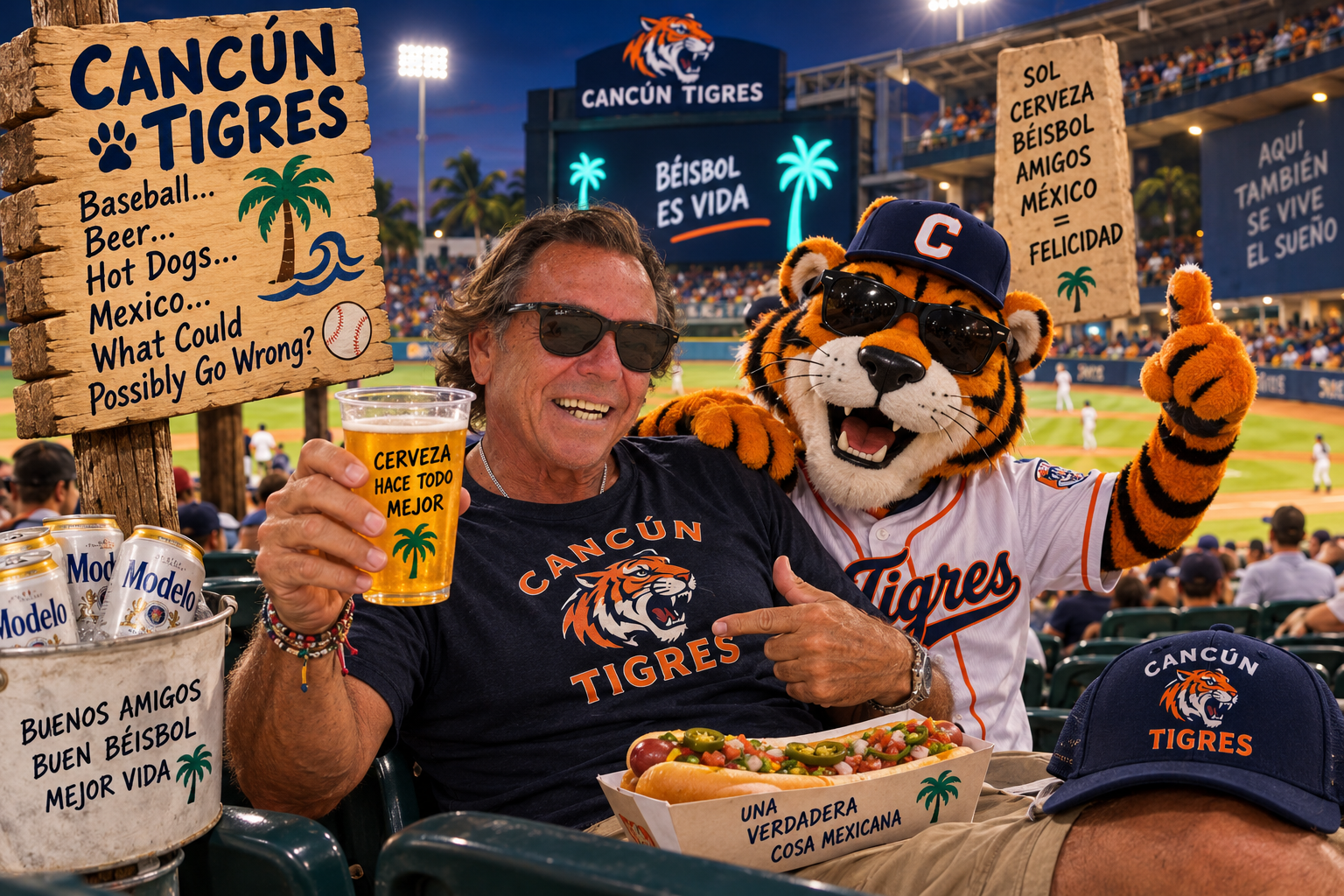
I’m a big baseball fan, so this immediately got my attention. Mexico has its own professional baseball league, and I had never been to a game. Baseball, beer, hot dogs, and Mexico sounded like a pretty good combination to me.
What could possibly go wrong?
Well… my first attempt didn’t go exactly as planned.
I had a beautiful Mexican friend with a five-year-old son who I knew would love the game. She was more of a friend than a girlfriend, although at my age I don’t spend too much time worrying about labels.
She spoke zero English. None.
My Spanish is better than it used to be, but let’s just say I’m not giving speeches in Spanish anytime soon. Between my Spanish and Google Translate, though, we managed to arrange a date at the game.
The biggest problem was transportation. I don’t have a car, and a taxi from Puerto Morelos to the stadium and back would cost around 1,600 pesos—close to a hundred dollars.
Very expensive. Muy caro.
Then a friend told me there was an air-conditioned bus that could get me there for about forty pesos.
Three bucks.
Now that sounded more like Mexico.
On game day, I took a colectivo toward Cancún and then waited for the connecting bus. When it finally arrived, it was packed, so I had to stand. At least it had air-conditioning.
I should explain that my Android phone at the time was basically useless unless I had Internet. Before leaving, I called my friend and told her I was on my way. We were supposed to meet at the stadium at 5:30.
Everything was going perfectly.
Which should have been my first warning.
We had gone maybe fifteen miles toward Cancún when a truck on the left suddenly decided he wanted to be in our lane.
SMASH!
He drove right into the bus.
The impact knocked me down. There were about thirty-five people onboard, and suddenly our nice air-conditioned ride to Cancún had become a traffic accident.
The driver managed to pull over safely and everybody got out. Now we were standing beside a busy highway waiting for another bus to come pick us up.
It was 5:15.
My friend and her five-year-old son were already waiting for me at the stadium.
And I had no Internet.
No Google Translate.
No way to tell her what had happened.
What fucking luck. Qué pinche suerte.
Eventually, I managed to flag down a taxi and went back home. Once I had Internet again, I tried explaining everything through Google Translate.
Apparently, Google Translate and an angry Mexican woman are not a particularly good combination.
She was sitting in the stadium parking lot with her little boy waiting for me and thought I had simply blown them off. I tried to explain the bus accident, but something was definitely getting lost in translation.
She was pissed.
Needless to say, I haven’t spoken to her since.
So much for my first Mexican baseball date.
But life goes on. La vida sigue.
Two days later, my friend Eric called.
“Hey, we’re going to the Tigres game tonight.”
Hell yes.
Attempt number two.
Eric was going with his beautiful girlfriend Jackie. I knew Jackie, and I also knew one important thing about her.
She’s always late.
The Internet said the game started at 6:30, so we planned to leave around five.
Jackie was ready around six.
Mexican time. Tiempo mexicano.
No big deal. The stadium was only about thirty-five or forty minutes away, and all three of us were excited to do something different. No beach. No cenote.
Tonight we were going to a Mexican professional baseball game.
Before we left, people had warned us about the stadium. Parking was supposedly expensive. Food was overpriced. Souvenirs would cost a fortune.
We arrived and quickly discovered most of that talk was bullshit.
First came parking.
A couple of bold Mexican guys tried to charge us 300 pesos to park Eric’s car. We completely ignored them, kept going, and found parking.
Total cost?
Zero.
Free. Gratis.
I liked Mexican baseball already.
The stadium was only about three blocks away. As we walked up the ramps, we looked over and saw another, even larger stadium nearby. Professional soccer players were practicing on the field.
That immediately gave us another idea.
We’d have to come back for a soccer game.
Something else to do during the endless summer of the Mayan Riviera.
But first—baseball.
We got to the ticket booth and Eric asked how much it would cost for the three of us. The attendant looked at Jackie and asked him, “Is she your girlfriend?”
“Yes.” Sí.
Apparently, that was the right answer.
There was a promotion that night and girlfriends got in free.
I immediately started wondering why the hell I hadn’t brought one.
The total cost for Eric and me was only 390 pesos—about twenty-seven dollars for two tickets to professional baseball.
What a deal. Qué trato.
We walked inside, and I was impressed. It was a nice stadium with good facilities and a huge video screen in the outfield.
We wanted to sit behind the Cancún Tigres dugout. According to their website, the Tigres were on the first-base side, just like I expected from baseball in the States.
Wrong.
The opposing team was on the first-base side.
The Tigres were on third.
Why?
Who the hell knows?
Only in Mexico. Sólo en México.
We settled into our seats around 6:45.
Remember, the game supposedly started at 6:30.
There were no players on the field.
The umpires were standing around behind home plate talking.
The grounds crew hadn’t even finished preparing the field.
Guys were still driving around smoothing the dirt.
Eventually, both teams came out around seven to warm up. The actual game didn’t start until around 7:45.
Another Mexican thing. Otra cosa mexicana.
While we waited, employees in bright yellow CERVEZA shirts came running over asking if we wanted beer.
Of course we wanted beer.
Why else would we be at a baseball game?
We ordered three tall boys for 120 pesos each. I had expected everything inside the stadium to be ridiculously expensive, but so far I was surrounded by bargains.
Then Jackie got hungry, so Eric and I went looking for food. We found loaded hot dogs with chili, jalapeños and every kind of Mexican salsa you could imagine.
Three hot dogs for 150 pesos.
Fifty pesos each.
Another deal.
I had expected to spend around 1,600 pesos that night. Instead, I had cheap tickets, free parking, reasonably priced beer and a loaded hot dog.
This might be the greatest professional sport in North America.
When the game finally started, there still weren’t many people in the stadium.
Eric told me, “Just wait. They’ll come.”
Sure enough, they did.
Apparently, Mexicans don’t necessarily arrive for the beginning of a baseball game. They arrive when they’re damn well ready.
No hurry. Sin prisa.
By the third inning, there were probably fifteen hundred people in the stadium.
Now the game itself was important. The Tigres only had six games left in the season and needed to win at least four to make the playoffs. That night they were playing the Piratas de Campeche.
I looked around and noticed something funny.
There seemed to be more Pirates fans than Tigres fans.
Then the game started.
The Tigres committed three errors in the top of the first inning.
Three.
The Pirates went ahead 1–0.
I’m sitting there thinking, “This is professional baseball?”
Then the Tigres came to bat.
And the Pirates committed three errors too.
Six errors in the first inning.
Now we’re talking.
Somehow the Tigres finished the inning ahead 3–1.
It wasn’t exactly Dodgers versus Yankees, but it sure as hell was entertaining.
The Mexican announcers were great—loud, excited, full of energy and apparently telling some wonderful stories.
At least I assume they were wonderful.
You had to understand Spanish.
The Tigres also had these crazy mascots running around the stadium. Flamboyant, energetic, dancing, carrying on and keeping everybody entertained between innings.
Mexican baseball had personality.
Lots of it.
At some point, Eric and I decided to walk around the stadium. That’s when I noticed murals of the great Mexican pitcher Fernando Valenzuela.
I knew Valenzuela from his years with the Los Angeles Dodgers, so I wondered why his picture was everywhere.
I later learned that Valenzuela had stepped in years earlier when the Tigres were struggling and helped keep the team connected to Cancún. He died in 2023 His family remained closely tied to the club.
That explained the murals.
Then I found the souvenir stand.
Now I was prepared for Major League Baseball prices. You know the drill—seventy bucks for a hat, forty bucks for a T-shirt, and maybe they’ll finance a jersey for you.
I found a beautiful white Cancún Tigres hat.
150 pesos.
About nine dollars.
So naturally, I bought four.
Of course. Por supuesto.
Now I’m sitting there with my beer, my hot dog and four bargain baseball caps, thinking this is one hell of a night.
Then suddenly—
Everything went black.
The lights went out in the entire stadium.
Not a few lights.
All of them.
The baseball game stopped and everybody just sat there in the dark.
I looked at Eric and started laughing.
Of course the lights went out.
My first attempt to see the Tigres ended with a bus wreck. This time we arrived late for a game that started even later, watched six errors in the first inning, and now the entire professional baseball stadium had lost power.
If this isn’t a Mexican thing, nothing is.
The lights stayed out for about thirty minutes.
By the time everything finally got moving again, it was getting close to ten o’clock and we were barely into the fourth inning. At this pace, we’d be eating breakfast before the final out.
Jackie had to work the next morning, so we finally gave up and headed home.
We never saw the end of the game.
Didn’t matter.
I loved it.
In my five years living in Mexico, that night became one of my favorite experiences. Not because the baseball was perfect. Hell no. That was part of what made it so much fun.
It was unpredictable, inexpensive, funny, chaotic and completely different from what I expected.
Exactly the kind of adventure I moved to Mexico for.
And remember how the Tigres needed to win four of their last six games to make the playoffs?
They won one.
No playoffs for the Tigres.
It’s over. Se acabó.
But I’ll definitely go back.
Next time, though, I’m not worried about getting there for the first pitch.
I’ll show up around the third inning.
Apparently, that’s when everybody else gets there.
A true Mexican thing. Una verdadera cosa mexicana.